
Setting Up a Home Rehab Gym
Essential Physiotherapy Equipment for Sports Injury Recovery

If you have just started your personal rehab journey, or perhaps you are an avid fitness enthusiast, chances are you want to kit out your home gym with the best physiotherapy equipment for sports injury recovery.
It can seem a little daunting to begin with, but hopefully we can help guide you on the essential physiotherapy equipment for your home rehab gym.
For those of you who have received a tailored rehabilitation programme after completing our online physio Symptom Checker, you will have noticed in your programme that we highlight, when it’s appropriate, what physiotherapy equipment would help you during your recovery. There is even a section at the end to show you where you can buy it, so that you can be sure you’ve picked the right make and model. We know from experience that simply Googling ‘Ankle Brace’ can be a bit of a minefield, so we’ve made choosing the right rehabilitation equipment straightforward.
We’ve also made it easy for you by compiling all the physiotherapy equipment we’ve suggested across all our programmes. Should you ever need, for example, a ‘cricket splint’, and not sure which one is needed, our Equipment section will show you our recommendation.
To build the perfect home rehab gym, you ideally want to pick the rehabilitation equipment which is the most versatile, not going to break the bank, and won’t take up half your living room when it’s not in use. There’s no point selecting physio equipment which has a very niche use and won’t be used on a regular basis. Our selection suggests the most essential physiotherapy equipment for sports injury recovery, based on maximum rehab usage.
We’ve chosen three essential pieces of physiotherapy equipment to have in your home rehab gym, along with two honourable mentions if you have some space and budget left at the end of it all.
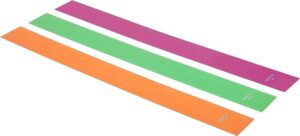
There’s a good reason the Resistance Band is used so widely within physiotherapy exercises. They are cheap, portable, easy-to-use and have hundreds of physiotherapy exercise variations. You can use it on every body part, in every direction. You can use a household item such as a door handle or a table leg to act as an anchor, or even your own body, further adding to its versatility.
For less than £10/$15, you can buy a multipack of resistance bands which will have different grades of tensile strength, allowing you to strengthen almost every muscle in your body. They also don’t take up any space in your house and because of this, they double as portable travel rehab equipment.
You can simply follow our YouTube videos of the exercises you want to do, and are unlikely to cause any injury in the process. As there is almost zero set-up time, you can use them instantly without prepping the area or building the equipment each time you want to use it.
Want to work the ankles? Some classic inversion and eversion resistance band exercises are ideal for ankle sprain rehab exercises. Need to build the glute muscles for running? Monster walks are a great option. Neglecting the posterior shoulder muscles after a heavy bench session? Focus your time on the external rotators of the rotator cuff.
The uses of resistance bands are endless, and it was an easy one to start the essential home physiotherapy equipment list with.
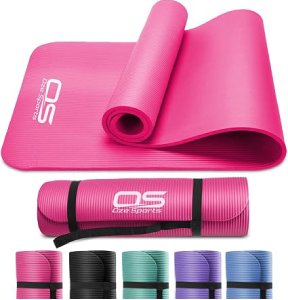
One of the hurdles that people often experience when using their home rehab gym and completing their physiotherapy programme or home workout, is the motivation to make it happen. Another common issue people working out at home can suffer from is losing that intensity during the session by distractions around the home.
This is where the simple yoga mat can help.
Having that physical piece which, when you roll it out, you know it’s time to start your home physio exercises, is key to getting started. It further acts as a focus point during your rehab programme that it’s time to work on your physio exercises and not become distracted with the home. If your yoga mat is rolled out on the floor and you’ve instead decided to start emptying the dishwasher, it offers that visual reminder that the home workout is not done, and you need to get back to your home physio programme.
Try it yourself and you will be amazed at the positive psychological impact it can have on your motivation.
At the end of the session, when your endorphins are flowing and you’re having to wipe clean the sweat from your workout, it offers that reinforcement you’ve done your home rehab exercises justice.
Aside from the mental benefit it brings, it unsurprisingly helps with many exercises by offering a more comfortable surface to perform your rehab exercises. A lot of stretching or core stability exercises require you to be laying down. Doing the Dead Bug exercise on a yoga mat, for example, will mean you have to stop when your core muscles are tired, instead of your hard floor irritating your back.
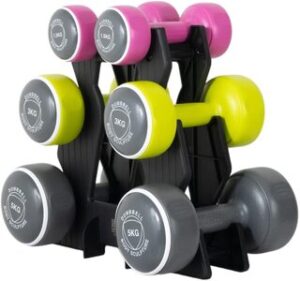
When you attend a commercial gym they have dumb bells ranging from 1kg all the way up 50kg. This is expensive and takes up a ridiculous amount of space, and if you are honest with yourself, how many do you actually use.
The advice on which weights to select here will be personal to you and your current fitness level, but realistically you can select 3-4 weights of dumb bells which allow you to perform a whole range of exercises.
Although the resistance bands can offer some great resistance, some movements it’s not enough, and you’ll need a greater level of resistance which you can get from dumb bells. This is why they make our list for essential physio equipment for your sports injury recovery.
Our hack here to save you some cash, is to search on Facebook marketplace for some absolute bargains. Gyms often sell old, unwanted kit which still have plenty of life left in them, or from people who had the best intentions but have been collecting dust ever since.
Admittedly, you won’t be able to have the steady progression of weights you’d get in a commercial gym, but you aren’t trying to compete with your local Anytime Fitness, you are creating your own personal home rehab gym, ready to go when you are.
If you need to start adding some weight to your squats or perform the shoulder press with more resistance, the dumb bell can help you hit that next level in your home rehab.
You can buy the classic dumb bell tree which may be helpful as a starter, but often you need something heavy. There is also the option of adjustable dumb bells, which allows you to add or remove the plates from the bar. These are great, because they offer a range in weight whilst taking up less space than dedicated dumb bells of each weight. However, they can be quite expensive and the cheaper ones can have the risk of the moving parts becoming worn and breaking earlier than you would expect.
Couple your dumb bells with your resistance bands, and there won’t be a muscle group or movement you can’t work on in your new home rehab gym.
The two honourable mentions which depending on your rehab goals and space are a Swiss Ball and Ankle Weights.
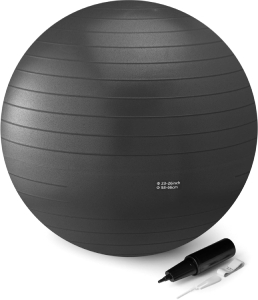
A Swiss Ball allows for a variety of core stability exercises to be completed, and you can add extra instability to some traditional exercises such as a press up or hip bridge. They’re also relatively cheap to buy, but the one limitation of this physio tool is the space needed to store them. They don’t easily get packed away in a cupboard, so unless you have a spare room to keep it in when not in use, it may become a bit annoying lurking around or inevitably rolling about your lounge.

Ankle Weights are another option which certainly has its place, but has the potential to become redundant fairly quickly, and has limited usage. If you are in the early stages of your rehab programme then these can be really helpful. Adding them to your knee extensions in sitting or side lying hip abduction can offer the next step of resistance you need.
Again, they’re relatively cheap to buy, and due to their size, can be easily packed away at home after a session.
However, once you move past the early stages of your rehab, they will likely become less utilised and compared to resistance bands and dumb bells, they offer less variety and ultimately less resistance.
Social media is rife with snake oil salesmen claiming that their piece of fitness equipment is superior and will address all your fitness and rehab needs. We, as consumers, love to see something new and can easily be swayed by the outrageous claims their shiny new fitness equipment can bring. They often always have an inviting “sale ending soon” and will inevitably have some absolutely ripped and toned model advertising their product, which we can almost guarantee did not get into their God-like physical state using their kit.
Be sceptical. If it seems too good to be true, we would hate you to waste your money on something which simply isn’t all that it’s claimed to be.
When setting up your home rehab gym, stick to evidence-based, simple physiotherapy equipment that allows for progressive loading and functional movement.
1
Get Started
Whether you pick the rehab equipment we have suggested for your home gym or not, the most important thing you do is start. Get a plan and stick to it, the first step can be the hardest and consistency is key.
2
Personalised Rehab
If you are struggling with motivation or accountability, our Rehab Tracker App can help you here. Follow your personalised rehab programme, guiding you through each phase, with notifications to help remind you to keep on track and progress tracking to see how well you’re doing.
3
Feedback
We’d love to hear what you thought about our essential physiotherapy equipment for sports injury recovery to help you set up your own home rehab gym. Anything we missed?
Physiobot offers a selection of digital tools designed to inform, guide, and educate and not a substitute for professional medical advice, diagnosis, or treatment. Always consult a qualified healthcare professional for personal advice regarding your health, diagnosis, or treatment options. By continuing to use this website and the Physiobot tools, you agree to our Terms of use.