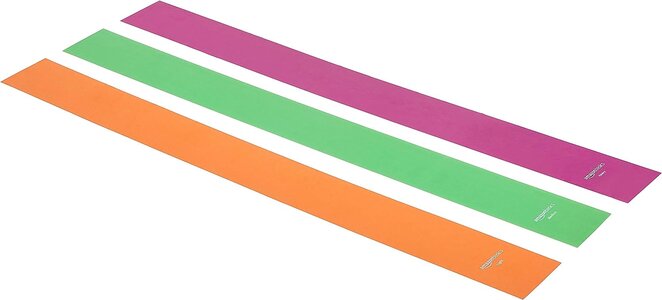
RESISTANCE BANDS Amazon Basics TPE Resistance Band, 3 Piece Set, 1500mm, Multicolor Buy Online (UK) Buy Online (US)



This page is split into collapsible sections to help you navigate to the most useful aspects of your rehabilitation programme.
This section covers an explanation of the diagnosis, what's going on within the body, and potential reasons that may have caused the issue in the first place. It gives some context, and helps explain the mechanisms at play, discussing possible lifestyle adjustments to prevent it from coming back.
Each programme is broken down into phases based on where you are in your recovery. Exercise videos will progress from initial, light exercises following injury, to more difficult, strength training as you recover. Within each phase are further drop downs, providing additional information about the phase and other interventions you could try.
Any equipment listed within the programme is linked within this section. We have hand selected our preferred suppliers of all equipment needed, with links on where to purchase each item; providing a low-cost, quality product to make purchasing online quick and easy.
A frozen shoulder is a condition which leads to a reduction in shoulder range of movement and often causes pain. From the testing you performed with a reduction in lateral rotation and abduction, and no pain on the resisted testing when the arm was in neutral, is a common presentation for a frozen shoulder.
The medical term for a frozen shoulder is ‘Adhesive Capsulitis’, as the cause of this condition is a tightness of the capsule which covers the entire shoulder joint. They still are not sure what causes people to suffer from a frozen shoulder, but there is a small link that an episode of trauma can trigger it, and females between 40 and 60 years old are more common to be effected. However, people with no history of trauma, who are male and not within that age bracket, can also suffer from a frozen shoulder. The timeframe to recover from a frozen shoulder can take up to 18 months, on certain occasions it can be much shorter, but unfortunately it can also take longer. It is almost impossible to predict how long someone will take to recover from a frozen shoulder. Generally speaking the individual will go through three stages; the freezing stage, the frozen stage, and finally the thawing stage. In the freezing stage the individual will begin to notice discomfort in their shoulder and certain activities will be more difficult. If someone is assessed by their family doctor or physiotherapists in the early stages of a frozen shoulder it may not be particularly obvious, and their pain may present as other shoulder issues, such as rotator cuff in origin. Eventually they will have the classic signs of a frozen shoulder, most noticeably restriction in passive range of movement in lateral rotation and abduction – moving your arm outwards. You may also find you have restriction in internal rotation, along with difficulty lifting your hand above your head. You will also find that to generate arm movements that you start hitching your shoulder up, by shrugging, to help compensate for the reduction in range. Once it is clearer that the movements are restricted you are said to be in the ‘frozen’ stage. Eventually these movements will begin to improve and your pain will reduce as you move into the ‘thawing’ phase. During each of the different stages you generally experience discomfort with a frozen shoulder, but it tends to be manageable if you reduce the amount of irritable movements you perform with your arm.
If there is a suspicion of a frozen shoulder you should be assessed by your family doctor of physiotherapist. They will be able to perform some simple mobility tests to determine if it is a frozen shoulder, or perhaps something else causing your symptoms. They may want to then refer you for an X-ray which can help confirm this diagnosis. In the early phases of a frozen shoulder it may be an option to receive a steroid injection which has shown in some circumstances to help alleviate both the pain and also improve the range, although this is best discussed with your family doctor. Another option available is to have a Manipulation Under Anaesthetic performed, or an MUA. An MUA involves a surgeon moving your shoulder whilst you are under a general anaesthetic in the hope to break up the restricted capsure which will improve your range. The evidence for this procedure is mixed, with it being helpful for some people but not others.
Further evidence has shown to help improve the symptoms of a frozen shoulder, and maintain the function of your shoulder, it is best to perform basic mobility exercises. You then need to wait for the condition to run its course and for the capsule tightness to reduce. Trying to work through the pain when performing range of movement exercises generally causes an increase in pain but without an increase in mobility. Any passive mobility treatments performed by a therapist may have a minimal short term improvement in range, but this generally comes with an increase in pain and the range quickly returns to the pre-treatment levels.
In spite of its long process to recovery, the encouraging thing to remember if that frozen shoulders do resolve over time, it just unfortunately takes a number of months to get there.
Phase 1
| Exercise | Reps / Sets | Freq |
| Elbow Flexion and Extension Range of Movement | 30 seconds x 2 sets | 5 x daily |
| Neck Active Range of Movement | 30 seconds x 2 sets | 5 x daily |
| Shoulder Pendulum Exercise | 30 seconds x 2 sets | 5 x daily |
This phase introduces some basic exercises which you can start, along with some options to help with the symptoms and general management of the condition.
You should arrange an appointment with your Family Doctor or another Medical Professional who will be able to perform some simple mobility tests to determine if you have a frozen shoulder, and may also refer you for an X-ray. You can continue with Phase 1 and 2 whilst you are waiting for this appointment and the X-ray result.
In the initial phase the use of over the counter medication may be an option. Medications such as simple pain relief and anti-inflammatories may allow the condition to be more manageable. Please consult your family doctor if you have any concerns with this impacting your current medication, or if any medical history may be impacted by the option of including this medication.
The focus on the exercises is to maintain the movement of your neck and elbow, and introduce a low level shoulder mobility exercise.
With shoulder pain it’s quite common to try and protect it, with the muscles surrounding the joint to tighten up as you are guarding it against any further damage. This can result in further discomfort, specifically neck and elbow pain.
Some things to consider with the exercises:
Phase 2
| Exercise | Reps / Sets | Freq |
| Shoulder Pendulum Exercise | 30-60 seconds x 2 sets | 2 x daily |
| Shoulder Extension Mobility | 30-60 seconds x 2 sets | 2 x daily |
| Shoulder Flexion Wall Climbs | 30-60 seconds x 2 sets | 2 x daily |
| Shoulder Internal Rotation Mobility | 30-60 seconds x 2 sets | 2 x daily |
| Shoulder External Rotation Mobility | 30-60 seconds x 2 sets | 2 x daily |
| Shoulder Abduction Mobility | 30-60 seconds x 2 sets | 2 x daily |
This phase we are looking at focusing on shoulder mobility exercises.
The exercises in this phase are designed for all stages of a frozen shoulder. As you are in the ‘freezing’ and ‘frozen’ stage they help maintain the mobility you have and can help act as a pain relief to the tightness. As you enter the ‘thawing’ stage it can be helpful to restore the range you have lost and ensure all directions are addressed.
You will notice there are no timelines of when each phase should be started, because the variety of timeframes is so variable with a frozen shoulder. It is important to perform these exercises regularly not just to help maintain the mobility you have, but it will also show to you when your shoulder range is improving and potentially the condition is improving.
You may find you want to continue the exercises from Phase 1 into this phase as well, which is absolutely fine. During this period the main focus is to introduce a variety of shoulder mobility exercises. There will be some which you find easy and may even offer some relief in the discomfort you are experiencing, others may be more challenging. You may also find it helpful to offer some variety on the angle you perform these exercises as it may make things a little easier. The point here is there is no set way to perform mobility exercises, and no two days will be the same. Don’t get discouraged by this and just make sure that you get something done at least once a day.
It’s unlikely that the exercises will restore full movement to the shoulder at this stage, and it is not uncommon for any change in mobility you experience to be short lived. These movements shouldn’t cause any spike in pain, but a little bit of discomfort is expected as you move into the restricted range.
The aim of these exercises is to offer some basic mobility to the shoulder without increasing your pain. Remember to start off easy and only increase the range after performing a few reps of each movement as a warm up.
Some things to consider with the exercises:
The evidence for the use of either Western or Chinese acupuncture to help with a frozen shoulder is mixed. It is unlikely to have any effect on the range of shoulder movement, but may help with the pain associated with this condition. If pain is a limiting factor affecting your quality of life it may be helpful to explore this option with a qualified acupuncturist.
During this phase your symptoms whilst resting should start to settle and generally you will only find an increase in pain when performing movements which are restricted, such as moving your arm above your head or reaching behind you.
Phase 3
| Exercise | Reps / Sets | Freq |
| Resistance band shoulder flexion | 12-15 reps x 3 sets | 2 x daily |
| Resistance Band Row | 12-15 reps x 3 sets | 2 x daily |
| Resistance Band Internal and External Rotation | 15-15 reps x 3 sets | 2 x daily |
In this phase we are looking at the stage when your shoulder movement has returned and you are in the ‘thawing’ stage of a frozen shoulder.
A good marker on when to progress onto this phase is when your mobility has improved and at roughly 75% range compared to the other side. You would expect your range to continue to improve, and should keep performing the exercises from Phase 2. Addressing any weakness in your shoulder which would have been caused from general lack of use, will help us restore the strength and endurance in this muscle group.
Start slow with these exercises, and remember it may have been many months since you focused on the strength of these muscles.
The aim in this phase is to re-introduce some resisted movements of the shoulder. Initially this may be discomforting to perform so don’t overdo it initially and give yourself enough rest between performing these exercises.
You should continue the mobility exercises from Phase 2 for at least 1 set but you can continue with more, and perform these exercises after them.
Some things to consider with the exercises:
At this stage you should find you can do more day-to-day activities pain free. The temptation here is to go a bit overboard. A nice reminder to pace activities so that you don’t over do it, and that you spread these activities out as much as possible throughout the day.
Depending on your sport or activity of choice, you may want to perform some upper body weight bearing exercises such as a plank or press ups. It may also be suitable to do higher level dumbbell strengthening exercises to further increase your strength.
As a general rule, try and aim for two pain-free training sessions at a reduced duration or intensity before increasing.
For example, if you normally play 60 minutes of tennis, aim to play for 30 minutes in a non-competitive environment for two non-consecutive days.
Having a day’s rest between sessions allows you to have appropriate rest and for your body to repair and become stronger.
Once you have found a duration or intensity you can tolerate with no flare up, aim to increase the next session by 10%. This can seem like a slow and conservative process however the research has shown this is the optimum level of increase to avoid an overuse injury. Increasing duration or intensity by more than 10% significantly increases your chance of injury, so only increase one or the other by this amount. As you will have been away from your sport for a number of months, you will have lost some of your fitness conditioning in this time and will need to build up slowly.
Over time you will be able to slowly return to your pre-injury level of activity without regressing back to any acute flare-up.
RESISTANCE BANDS Amazon Basics TPE Resistance Band, 3 Piece Set, 1500mm, Multicolor Buy Online (UK) Buy Online (US)
Before printing or downloading your programme, expand all of the drop down sections that you’d like to capture within your downloaded Full Report. Any sections that are closed will not be downloaded.
The button below will open a print window. Simply save the page as a PDF to have your offline full report, anytime.
This rehab programme spans multiple weeks. Don’t forget to bookmark this page to come back to later.

Physiobot is a free digital tool designed to inform, guide, and educate and not a substitute for professional medical advice, diagnosis, or treatment. Always consult a qualified healthcare professional for personal advice regarding your health, diagnosis, or treatment options. By continuing to use this website and the Physiobot tools, you agree to our Terms of use.